Your first yes should pay for the next one. The staircase after the sale.
Most of us stop selling after the first yes. Hormozi's $100M Money Models says that's where the real money starts. Here's the staircase, in plain words.
A customer says yes. You send the invoice. You do the work. Then what?
For most of us, nothing much. Bas. We go back to hunting for the next stranger.
I've been reading Alex Hormozi's $100M Money Models. It came out in August 2025. His big point is simple. That first yes is not the end. It's the first step on a staircase.
So what's Hormozi actually saying?
He puts it plainly: "A Money Model is a deliberate sequence of offers." In normal words, one offer, then the next, in a planned order.
The goal is bold. Your customers should pay for the cost of winning them. One customer should bring in enough cash to win and serve at least two more. And in under 30 days.
He starts his chapter on upsells with McDonald's. You order a burger. They ask, do you want fries with that? The burger barely makes money. The fries and the cold drink do. His point, roughly: no fries, no McDonald's.
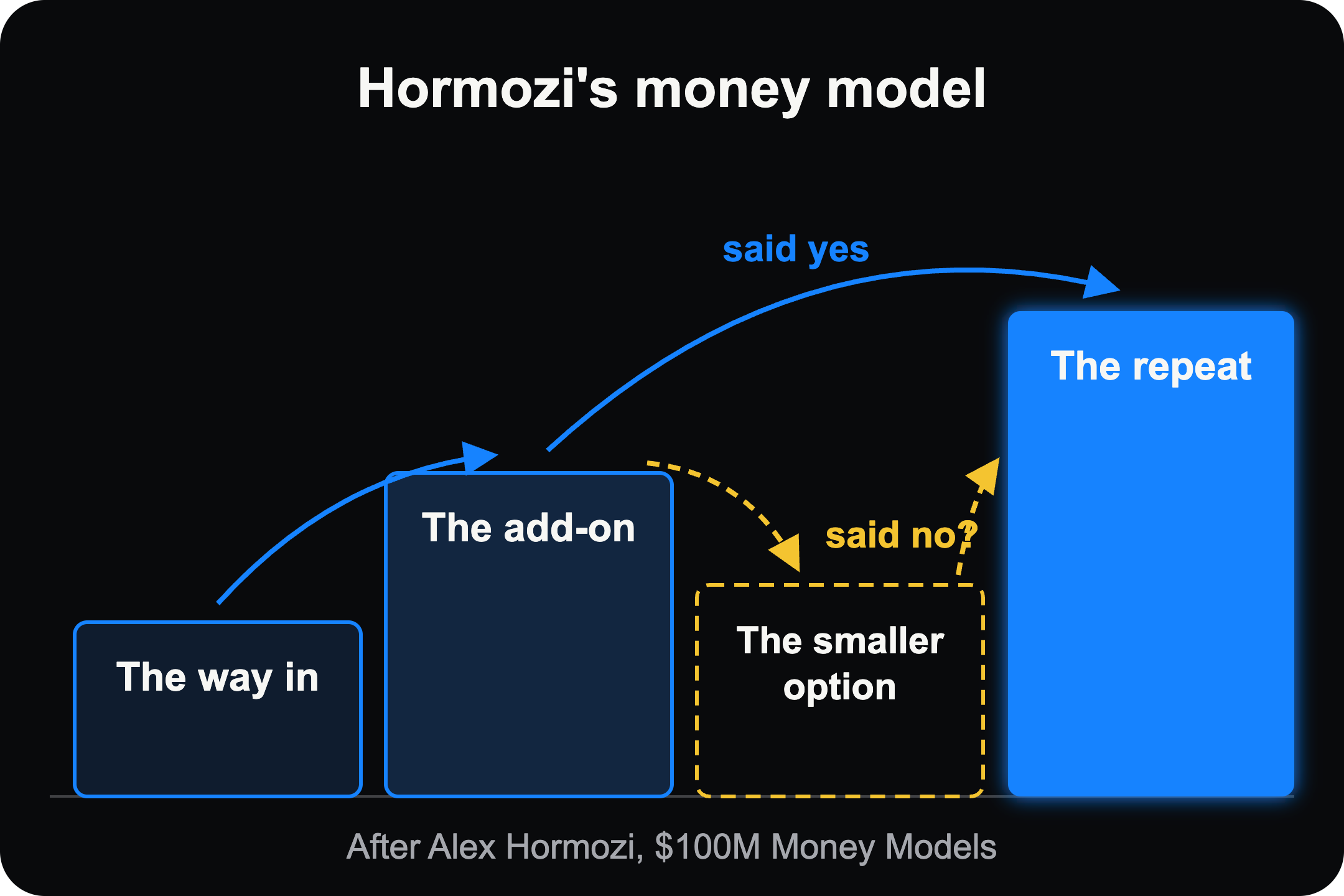
The four steps, in plain words
Hormozi sorts offers into four kinds.
The way in. He calls these attraction offers. Something free, cheap or an easy yes. It brings strangers through the door. It doesn't need to make much profit.
The add-on. He calls it the upsell. It's the next thing you offer right after the yes. This is where the real profit sits. The fries, basically.
The smaller option. He calls it the downsell. It's for people who say no. Here's the thing: it's not just "same thing, cheaper". You change the terms. Pay in parts. Try it first. Take fewer features.
The repeat. He calls it continuity. Stuff people pay for again and again. A yearly contract, a retainer, a membership.
Think of your local dhaba. You come in for chai. Then the samosa shows up. Too full? Half plate. And the regulars come back every evening. That's the whole staircase.
What this looks like in a real business
Picture this, a made-up example. You do office interiors.
Your way in could be a free walk-through. You visit the office and show the client what's not working. Easy yes.
Once they sign for the full job, you offer furniture and signboards. That's the add-on. It solves their very next problem.
Some clients say the project is too big. Don't let them walk. Offer one floor first. That's the smaller option.
Then a yearly maintenance contract keeps you in the building. That's the repeat. Steady cash, every year.
If cash is what holds your growth back, maybe marketing isn't the problem. Maybe it's what you offer after the first yes.
Where I'd push back a bit
First, the 30 days. That target suits businesses that run ads and need their money back fast. If your sales take three months, relax. Use the idea, not the clock.
Second, a line of offers can start to feel like a line of sales pitches. Straight up, nobody likes being sold to all day. So each offer must solve the customer's next real problem. If it doesn't, skip it.
Third, don't build all four at once. That's a full-on recipe for confusion. Start with one step. Make it work. Then add the next.
Try this week
Take the thing you sell most. Write down the first 7 days after a customer says yes. What do they need next? Pick the most obvious need.
Offer it to your next 5 customers. Count how many say yes. That number tells you if your next step is real.