Your customer is the hero. You're the guide who helps them win.
Donald Miller's StoryBrand has one simple rule: the customer is the hero and your brand is the guide. Here's what that means for the first line of your website.
I've been reading Donald Miller's Building a StoryBrand. It came out in 2017. A fully revised version, Building a StoryBrand 2.0, landed in January 2025.
One idea stuck with me. Your customer is the hero. You're not.
So what's Miller actually saying?
Every good film has the same bones. Miller boils them down to seven parts.
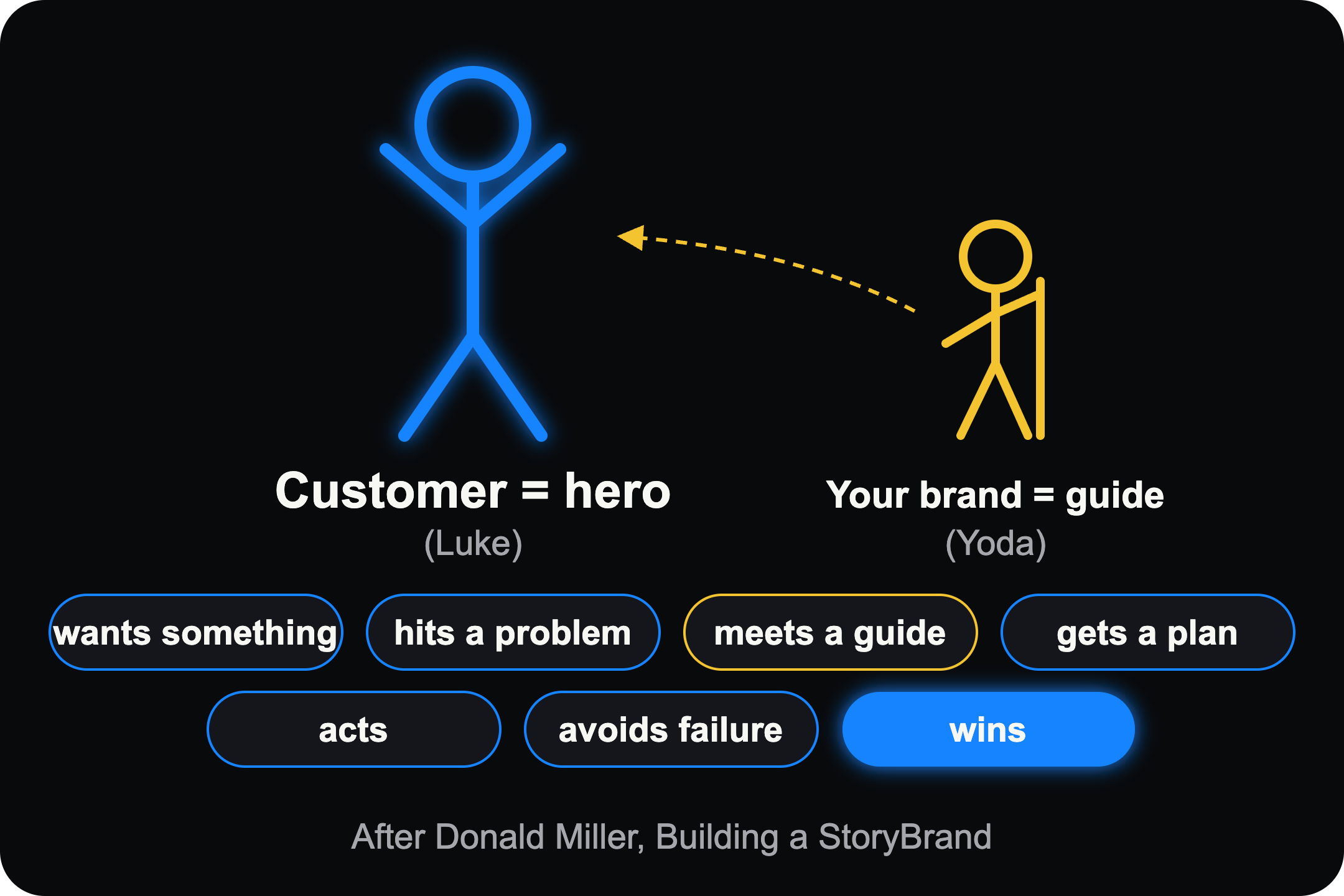
Here they are in plain words. A person wants something. They hit a problem. They meet a guide. The guide gives them a plan and asks them to act. That helps them dodge failure and win.
Now the twist. In your business, the customer is that person. Your brand is the guide.
Miller uses Star Wars to make it stick. Think Yoda, not Luke. Luke is the one who has to win. Yoda has been there before and helps him do it.
Here's the thing. When a brand tries to be the hero, it fights the customer for the same role. And the customer always wins that fight. They just walk away.
So how does a guide earn trust? Two things, says Miller. Understanding and know-how. One says, "I get what you're going through." The other says, "I know how to fix it." You need both. Understanding alone feels soft. Know-how alone feels like bragging.
Let's be real about your website
Open your website or company profile. Read the first line.
I'd bet it sounds something like this. "Established in 1994. Our 80,000 sq ft factory. ISO certified. Award-winning."
None of that is false. It's just in the wrong place.
A buyer reads that and thinks one thing. Okay, so what does this mean for me?
Think of a wedding planner. Nobody comes to a wedding to look at the planner. The couple is the hero. The planner makes sure the food, the lights and the baraat all turn up on time. A good planner is kind of a big deal. But the photos are of the couple. Bas.
So where do your years and awards go?
Picture this, a made-up packaging company.
Their old first line: "Founded in 1998, we are a leading manufacturer…"
A better one: "Your products reach the shelf undamaged and on time. Three factories and 25 years of practice make sure of it."
See the shift? Same facts. But now the customer is the subject. The factories and the years have a job. They're the proof, not the headline.
Your years in business are not the story. They are the reason the customer can trust you inside their story.
Here's what I'd push back on
First, sameness. Once everyone follows the same formula, every website starts to sound alike. A formula is a tool. It's not a script.
Second, how business works here. A lot of trust in India comes from people, not pages. Relationships. References. A factory visit with chai. No website line replaces that.
Third, the buying team at a big company. Some of them really do want your list of machines and certificates first. For them, hiding it is a deal-breaker. So don't hide it. Just don't lead with it everywhere.
Still, the main idea holds. Talk about their win first. Then show why you're the one to help.
Try this week
Rewrite the first line of your website or company profile. Make the customer the subject of the sentence.
Move your "since 19XX" line further down, as proof.
Then show both versions to one customer you trust. Ask which one sounds like it's about them.