Try it. Then try it again. The AI habit Mollick is really teaching.
Ethan Mollick's Co-Intelligence says try AI on everything. Try, not trust. What it's good at and bad at is uneven, and you only find out by testing.
I've been reading Ethan Mollick's Co-Intelligence: Living and Working with AI. It came out in April 2024.
He gives four rules. Always invite AI to the table. Be the human in the loop. Treat AI like a person, but tell it what kind of person it is. And assume this is the worst AI you will ever use.
Two of these stuck with me. The first one and the last one. Let me tell you why.
So what's Mollick really saying?
"Invite AI to the table" means try it on everything. The only stop signs are the law and plain right and wrong. Note the word. Try. Not trust.
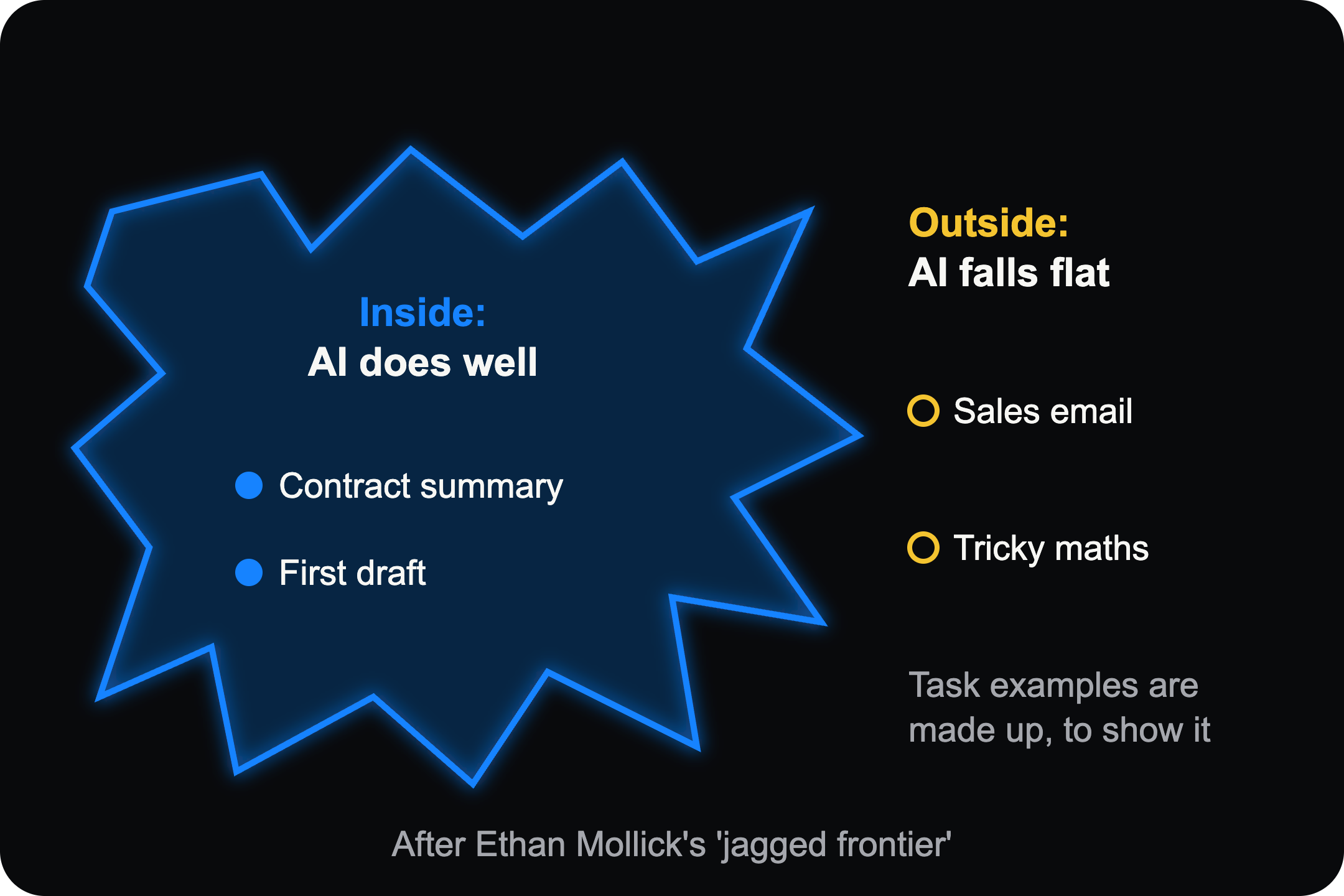
Why try everything? Because of what he calls the "jagged frontier". Picture a fort wall with a zig-zag edge. Some jobs sit inside the wall, where AI does well. Some sit just outside, where it falls flat.
Here's the thing. Two jobs can look equally hard. One lands inside, one lands outside. You can't tell which by looking. Mollick's answer is simple. You have to try.
Then the last rule. The AI you use today is the weakest one you'll ever use. So a "no" today may be a "yes" in a few months.
Why this is kind of a big deal for owners
Let's be real. A lot of owners tried a chatbot once. They got an average answer. They closed the tab. Done.
Others are still waiting for the "right" tool. They want it perfect before they start.
Both are making the same mistake. They treat AI as a one-time decision. A yes or a no. Bas.
But that zig-zag wall says it's not one decision. It's a map. And you only draw a map by walking.
Picture this, a made-up example. Say you run a distribution business. Week one, you ask AI to write a sales email. It's flat. You'd never send it.
Week two, you ask it to sum up a long supplier contract. It nails it. Clear points, the risky bits pulled out, an hour saved.
Same tool. Same owner. Two very different results. If you had quit after week one, you'd never have found week two.
One bad answer is not a verdict. It's one clue. Keep collecting them.
Hold on, a little push back
"Try it on everything" doesn't mean hand over your customer data. Mollick's own stop signs matter. Keep private stuff private.
And "it'll get better" can turn into an excuse. "Let's wait for next year's version." That's just waiting with a nicer name.
This is where "be the human in the loop" comes in. Mollick suggests picturing AI as a super-fast intern. Eager to please. But it sometimes bends the truth.
So check its work like you'd check a new hire's. Read it. Fix it. Make the final call yourself. No chalta hai.
The real shift
Stop asking, "Is AI good or not?" That question has no useful answer.
Ask a better one each week. What did it get right? What did it get wrong?
That's how the map fills in. Slowly. One job at a time. Straight up, it's a habit, not a decision.
Try this week
Pick one real task each day, Monday to Saturday. Do it with AI first, before you do it yourself.
After each one, write two lines. What did it get right? What did it get wrong?
On Saturday evening, read all six notes together. Look for the pattern. Then do it again in a month, and see what changed.