Name the feeling before the fix. An upset person can't hear your answer yet.
Chris Voss spent years talking people down in hostage situations. His simplest tool works in any tense client call: say the feeling out loud, then go quiet.
I've been reading Never Split the Difference by Chris Voss, written with Tahl Raz (2016). Voss was an FBI hostage negotiator. So when he says calm a person down before you try to solve anything, I listen.
Here's the one idea I keep coming back to. When someone is upset, name the feeling before you offer the fix.
Why the fix doesn't land
Let's be real. When a client is angry, most of us jump straight to the answer. "Sir, we'll send a new one tomorrow." "Madam, we'll give you a discount."
But an upset person isn't ready for your answer yet. They don't feel heard. So your perfectly good fix bounces right off.
Think of a pressure cooker. You can't open the lid while the steam is still inside. First the whistle, then the lid. Feelings work the same way.
Say what you see
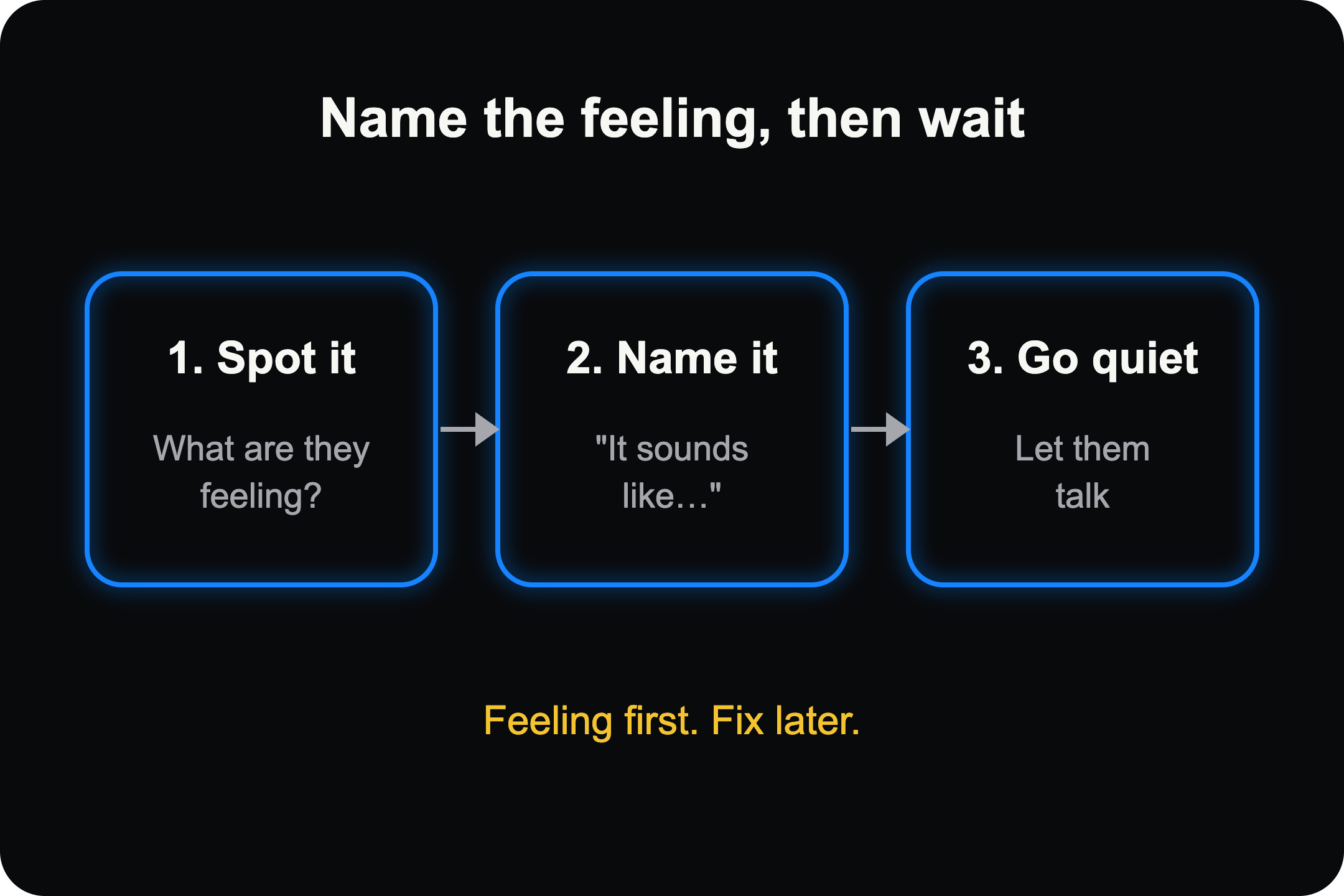
Voss calls this labelling. In plain words, you say out loud the feeling you notice in the other person.
He gives simple starters: "It seems like…", "It sounds like…", "It looks like…". Then you add the feeling. "It sounds like you feel let down." "It seems like this delay has messed up your whole week."
Notice what's missing. The word "I". Voss points out that "I'm hearing that…" puts people's guard up, because now it's about you. "It sounds like…" keeps the spotlight on them.
And here's the thing. You don't have to agree with them. You're just showing you see what they feel.
People don't calm down when you're right. They calm down when they feel seen.
Then comes the hard part. Voss says the last step of labelling is silence. Put the label out there, then stay quiet and listen. Most of us can't bear the pause. Don't rush in. Let them fill the gap. That's usually when the real problem comes out.
A quick word on mirroring
His other simple tool is the mirror. You repeat the last few words, or the key one to three words, of what they just said. Then you stay quiet again.
Picture this, a made-up example. A supplier says, "We just can't hold this price anymore." You reply, softly, "Can't hold this price?" Then wait. Often they'll start explaining why. Now you know what you're actually dealing with.
Voss even talks about the voice to use. He calls it the late-night FM DJ voice: deep, soft, slow and calm. Not the voice of a man arguing at a railway ticket counter. The voice of someone with all the time in the world.
Feeling first, fix second
Bas, that's the whole method. Spot the feeling. Name it. Go quiet. Only then bring your fix.
It sounds too simple. That's kind of the point. In a tense room, simple is what people can actually take in. And once someone feels understood, your fix stops being a fight and starts being a chat.
Try this week
Pick one tense conversation this week, with a client, a staff member or a vendor. Before you offer any solution, say one line that starts with "It sounds like…" and names their feeling. Then count to four in your head and say nothing.