Make an offer they can't refuse. Carry the risk yourself.
Sabri Suby calls it the Godfather Offer. Strip away the film reference and it's one simple question: when someone buys from you, who carries the risk?
"Make an offer they can't refuse." Sounds like a sales trick, right? It isn't. Here's the thing. It's a question about risk. Who carries it when someone buys from you?
I've been reading Sabri Suby's Sell Like Crazy. He lays out an eight-step system. Step 4 is what he calls the Godfather Strategy. Yes, the name comes from that famous film line. But the idea is plain business sense.
So what's Suby actually saying?
An offer has two parts. What the buyer wants. And what they must do to get it.
So "We make packaging. Here is our rate." is not an offer. That's a product and a price. Bas.
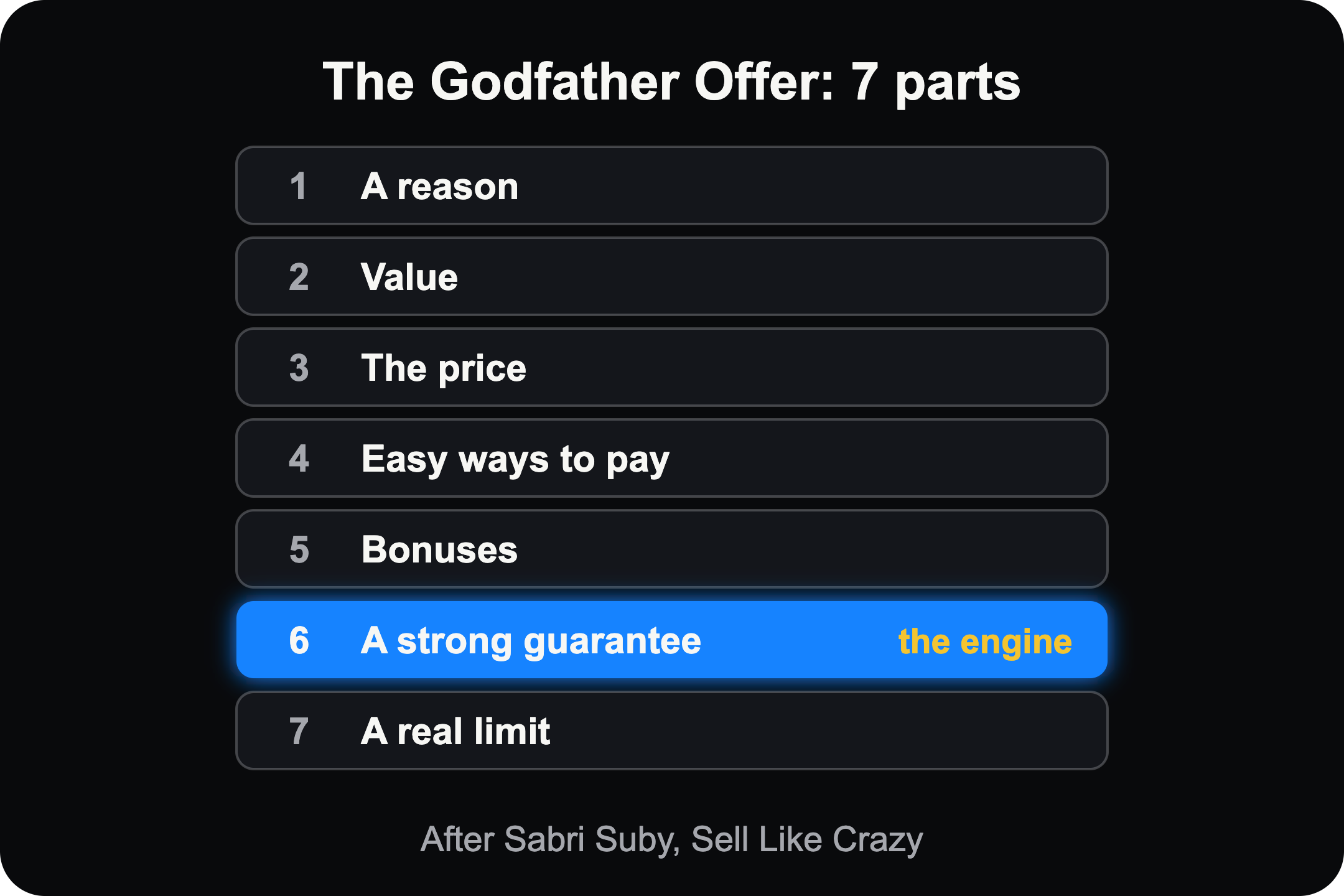
Suby's Godfather Offer has seven parts:
- A reason. Why are you being so generous? Give a reason people can believe.
- Value. Show what people normally pay for this.
- The price.
- Easy ways to pay. Not one big hit.
- Bonuses. Extras that sweeten the deal.
- A strong guarantee.
- A real limit. On how many, or for how long.
His test is simple. Your offer should make you a little nervous. If it feels totally safe for you, it probably feels risky for the buyer.
The guarantee does the heavy lifting
Of the seven, the guarantee is the engine. It moves the risk off the buyer and onto you.
But it has to be clear and exact. In Suby's words, it "should be specific, not some vague notion of 'satisfaction'."
"100% satisfaction" promises nothing. Nobody believes it. Compare that with "Delivered by the 10th, or the delivery charge is on us." Now you've taken away a real fear.
What this means for your business
Think of the sabzi wala who lets you pick and press the tomatoes before you pay. He's carrying the risk. So you stop worrying and buy.
Your buyer isn't comparing you with competitors. They're comparing you with the risk of choosing wrong.
That fear is different for everyone. A purchase manager fears a late delivery that gets them blamed. A family buying a home fears a builder who disappears. A hospital fears a machine that breaks on a busy night.
Picture this, a made-up example. A factory that makes parts for other companies says: "Miss a delivery date, and we pay you a fixed amount for every day we're late." Suddenly, saying yes is a no-brainer. Saying no feels foolish.
Okay, but where I'd push back
Let's be real. Some of this needs care.
Fake limits. We've all seen the "only 2 left!" banner that never changes. Buyers here spot that trick fast. Suby says the limit must be real. If it's fake, you lose trust.
Big company buyers are different. They won't trust a line in your brochure. Put the promise in writing in the contract. Or start with a small paid trial order.
Can you afford it? Do the maths first. A guarantee you can't keep is just a lie with a delay.
Stay honest on value. Don't pile on bonuses with made-up "worth" price tags. Buyers see through it.
Try this week
Write down the single biggest fear your best buyers have. One fear. Not five.
Now rewrite your main offer so you carry that fear, not them. Make it exact. A date, an amount, a clear payback.
Then ask two questions. Can we keep this promise nearly every time? And would saying no to this feel foolish? If both answers are yes, you've got your offer.